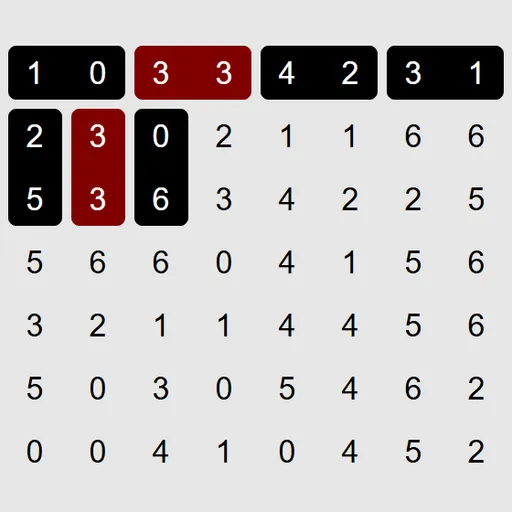
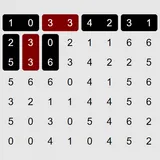
Dominosa Domino Logic is a deduction puzzle that starts after the dominoes are gone. Picture a full set laid out in a rectangle, with the numbers copied onto the grid before the tiles were lifted away. You only see those numbers. Your job is to work out where each domino sat. This is Dominosa from Simon Tatham’s Portable Puzzle Collection.
The Core Rule
A domino set contains every pair of numbers exactly once, doubles included. So if the grid uses 0 to 6, there is one 0-0, one 0-1, one 3-5, and so on, for 28 dominoes in all. Each domino covers two squares that sit side by side or one above the other.
Your finished answer must cover every square and use each pair once. No pair may repeat, and no pair may be missing.
Laying Dominoes
Click or tap the gap between two neighboring numbers to place a domino across them. Click again to remove it. If a new domino overlaps old ones, those are cleared.
You can also mark gaps where a domino cannot go. Right-click, press Space, or press and hold on touch to draw a short line there. These marks are just notes, but they help a lot on big grids.
If you place a pair twice, both copies turn red. That makes mistakes easy to catch.
How to Control Dominosa Domino Logic
| To do this | On a keyboard | With a mouse | On a touchscreen |
|---|---|---|---|
| Add or clear a domino | Move with Arrow keys to a gap between two numbers, then press Enter | Left-click the gap between two adjacent numbers | Tap the gap between two adjacent numbers |
| Add or erase a "no domino here" line | Press Space | Right-click the gap between two numbers | Long-press the gap between two numbers |
| Highlight all copies of a number | Type that number | Right-click the number itself | Long-press the number itself |
| Undo, redo or start a new puzzle | Press U / R / N | Use the Undo move, Redo move and New game buttons | Use the Undo move, Redo move and New game buttons |
Sizes and Levels
The Type menu holds presets with numbers up to 3 through numbers up to 9. Small sets are quick warm-ups, and big ones are long solves. Difficulty runs Trivial, Basic, Hard and Extreme. Each of these has a single answer, and higher levels need deeper reasoning.
You can highlight every copy of a number by typing it, right-clicking it or holding on it. Up to two numbers can glow at once.
Ways to Crack a Grid
- Search for lonely pairs. Pick a pair, like 2-5, and find every spot where it could fit. If only one spot exists, place it.
- Squeeze trapped squares. A square with only one free neighbor must pair with that neighbor.
- Rule out used pairs. After you place a pair, mark lines on every other place it could have gone.
- Use highlights. Lighting up two numbers shows where they sit next to each other.
- Look hard at doubles. Two equal numbers side by side may be the only home for that double.
Who It Suits
This puzzle is for people who enjoy pure logic and steady progress. There is no timer, so you can work at your own pace. It plays well with a mouse, a keyboard or touch. If you like number deduction, try Greater Than Grid or browse more puzzle games.
Last played and checked by SZ Games: