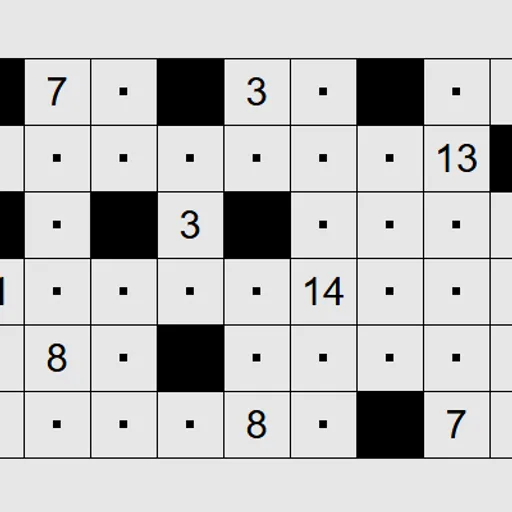
Range Shading Puzzle is a pencil-style logic grid about what each number can see. Clues sit in some squares. You decide which blank squares turn black so that every clue looks out over exactly the right number of white squares. Behind it is Range, a puzzle Jonas Kölker added to Simon Tatham’s Portable Puzzle Collection.
The Four Rules
A finished board meets all of these at the same time:
- Squares with numbers stay white.
- Black squares never share an edge. Touching at a corner is fine.
- Every white square connects to every other through edges, forming one region.
- A number equals the white squares it sees looking up, down, left and right, counting itself. Its view stops at a black square or the edge.
You will never see a clue of 1. It would need black on all four sides, which would cut it off from the rest of the white area.
Working a Board
Left-click to shade and right-click to place a dot, which is your note that a square must stay white. Clicking again cycles through black, dot and empty. On touch screens, press and hold to dot, or flip the Tap switch under the grid. You can also swap the mouse buttons in Preferences.
How to Control Range Shading Puzzle
| To do this | On a keyboard | With a mouse | On a touchscreen |
|---|---|---|---|
| Fill a square black (press again to cycle) | Move with the arrow keys, then press Enter | Left-click it | Tap it while Tap is set to Shade black |
| Dot a square as definitely white (press again to cycle) | Press Space | Right-click it | Press and hold it, or set Tap to Dot and tap |
| Leave dots on every square you cross | Shift + arrow keys | — | — |
| Start new, undo or redo | N, U, R | Use the menu buttons above the grid | Use the menu buttons above the grid |
Logic That Helps
- Count the widest view. If a clue’s row and column together hold exactly its number, every square in them is white.
- Dot around black. As soon as you shade a square, dot its four edge neighbors.
- Small clues are strong. A 2 sees only one other square, so three of its four directions must be blocked right away.
- Guard the connection. Any black square that would close off a pocket of white is wrong, so check corners and edges.
- Use shared lines. One black square in a row can limit two clues at once.
- Trail dots fast. Hold Shift and press the arrows to dot a long line you have proved white.
Who It Is For
This puzzle fits people who like steady deduction with no guessing. Small boards make a short break, and the 16 by 11 preset can fill a long evening. Everything is drawn in code, so it loads fast on a phone or desktop. For more grid logic, try Light Up Lamp Puzzle or the rest of the puzzle games.
Last played and checked by SZ Games: