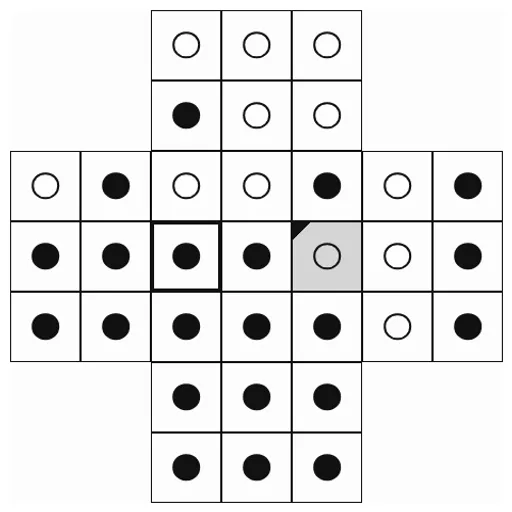
Peg Solitaire gives you a board full of pegs with one empty hole, and a single question: can you clear it down to one? Each move is a jump. You hop one peg over a neighbor into an open hole, and the peg you hopped over comes off. The rule takes a few seconds to learn, but the order of your jumps decides everything. This build comes from Christopher Müller’s open-source PaperGames set and uses a crisp black-and-white look.
The Goal and the Boards
You win when exactly one peg remains. Any spot on the board is fine. If you reach a point where no jump is possible and two or more pegs are left, the game is over and it tells you the count.
There are six layouts to choose from. You get the 33-hole English cross, the 37-hole European board, a 45-hole German cross from 1779, a 6 by 6 square, a 41-hole diamond and a 15-hole triangle. Each one starts from a hole that is known to be solvable.
Making a Jump
Click or tap a peg to pick it up. The game then marks every empty hole that peg can reach. A legal target is two spaces away in a straight line, with a peg sitting in the gap. Choose a marked hole and the jump happens at once.
On square-grid boards you can only jump up, down, left or right. The triangle is different: its pegs also jump along both slanted lines. A peg counter above the board drops by one after every move, so you always know how far you have to go.
How to Control Peg Solitaire
| To do this | On a keyboard | With a mouse | On a touchscreen |
|---|---|---|---|
| Choose a peg to jump with | Tab onto the peg (use arrow keys to travel the board), then press Enter | Click on the peg | Tap on the peg |
| Hop into an empty hole | Go to the highlighted empty hole, then press Enter | Click a highlighted empty hole two spots away | Tap a highlighted empty hole two spots away |
| Reverse your last jump | — | Press the "Undo" button | Tap the "Undo" button |
| Switch boards or start over | — | Select a board, then click "New game" | Select a board, then tap "New game" |
Ways to Plan Ahead
- Keep pegs in groups. A peg with no neighbors can never move or be taken, so one lonely peg means the puzzle is lost.
- Work the edges early. Corners and arm tips are the hardest spots to clear later. Deal with them while there are still pegs around to jump with.
- Finish one area before starting another. On the cross boards, empty one arm fully before you turn to the next.
- Look for three-in-a-row patterns. A short sequence of jumps can often remove a line of three while leaving the rest connected.
- Undo freely. There is no limit, so back up a few moves the moment you spot a peg about to be cut off.
Who Will Enjoy It
This is a calm, no-timer puzzle. It suits anyone who likes thinking a few moves ahead and does not mind starting over. You can play with a mouse, by touch, or with the keyboard alone using arrow keys and Enter. If you want more quiet logic after this, try Tower of Hanoi or browse the rest of the puzzle games on SZ Games.
Last played and checked by SZ Games: