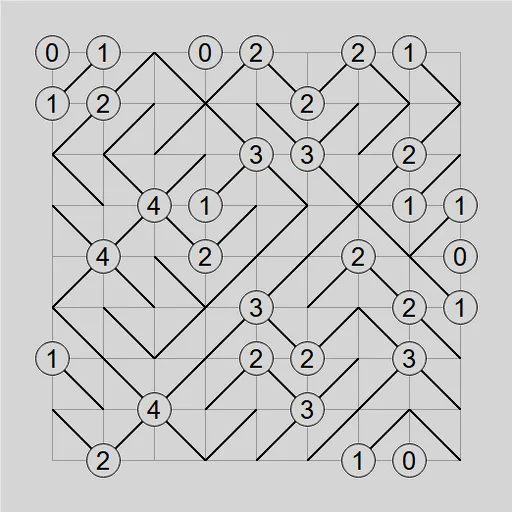
Slant Diagonals is a grid puzzle with only one kind of piece: a diagonal line. Each square gets a line that leans one way or the other. Numbers in small circles sit on the corners of the squares, and each one says how many lines must touch that point. The puzzle comes from Simon Tatham’s Portable Puzzle Collection, where it is called Slant.
Two Rules to Remember
The first rule is the clue count. A corner point can touch up to four squares. If the clue there is 3, exactly three of those squares must have a line running into that point. A 0 means every nearby line points away.
The second rule is about loops. Your lines may never join up into a closed shape, no matter how big. In a solved grid, every chain of lines runs out to the border.
Playing a Board
Click a square with the left button for a \ line or the right button for a / line. Click again to cycle to the other line and then back to empty. On a phone, a tap cycles the line, and a press-and-hold starts from the other direction. A switch under the grid changes what a plain tap does.
How to Control Slant Diagonals
| To do this | On a keyboard | With a mouse | On a touchscreen |
|---|---|---|---|
| Draw or cycle a \ line | Move with the arrow keys, then press Enter | Left-click the square | Tap the square while Tap is set to "\ first" |
| Draw or cycle a / line | Press Space | Right-click the square | Press and hold, or set Tap to "/ first" and tap |
| Set a square straight to one direction / clear it | Type / or \ / Backspace | — | — |
| Start new, undo or redo | N, U, R | Use the menu buttons above the grid | Use the menu buttons above the grid |
The grid flashes when you finish. Undo and redo have no limit, and a Solve option is there if you want to check the answer.
Ways to Make Progress
- Begin with clues of 0 and 4. They fix all the squares around them at once.
- Clues on the outer edge only touch two squares, and corner clues touch one. These are quick wins.
- When a clue already has enough lines, turn every other square around it away.
- If three sides of a tiny diamond are drawn, the last square must lean the other way.
- After placing a line, look at both of its ends. One line can finish two clues.
Who It Suits
This is a good pick if you like quiet logic with no timer. Small grids take a few minutes, while a 12x10 Hard board can fill a long coffee break. For more puzzles of this kind, try Light Up Lamp Puzzle or browse the full list of puzzle games.
Last played and checked by SZ Games: