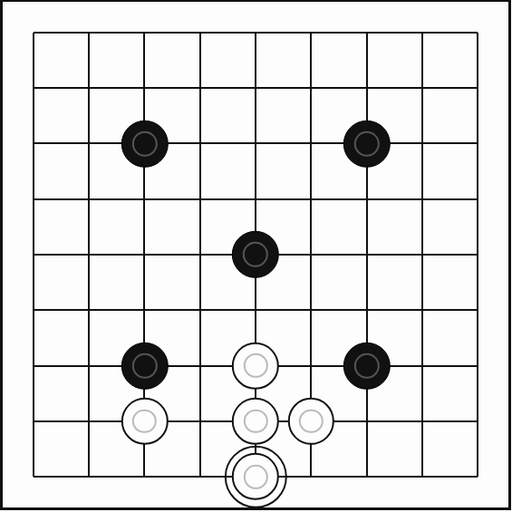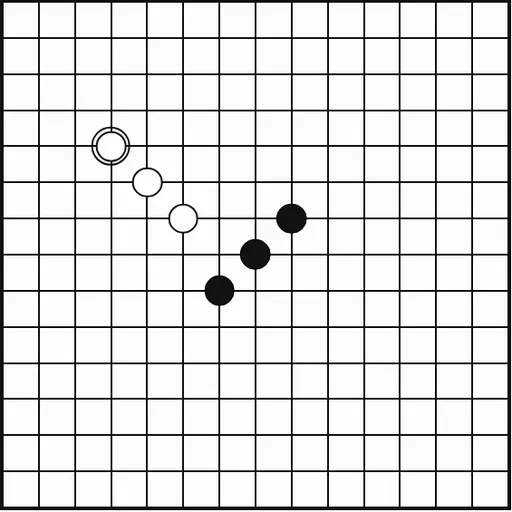
Gomoku is a simple game of stones and lines. Two players take turns placing stones on the points of a grid, and the first to make a line of five wins. This version from Christopher Müller’s open-source PaperGames collection uses a 15x15 board. You can learn the rules in a minute, but the battle over open lines gets tricky fast. Play a friend on one screen or face the computer at three levels.
Rules at a glance
Black goes first, then players alternate. On each turn, put one stone on any empty point where two lines meet. Stones never move and are never removed.
Your goal is an unbroken line of five or more of your stones. It can run across, up and down, or along either diagonal. The game ends the moment someone completes one. If the board fills without a line of five, the game is a draw.
Setting up a game
In computer mode, pick black to move first or white to reply, then choose Easy, Medium or Hard. In two-player mode, you and a friend share the device and take turns tapping the board.
Undo takes back your last stone. Against the computer, it also takes back the computer’s reply, so you get your turn again. The game asks before you resign or restart, so you will not lose a game by accident.
How to Control Gomoku
| To do this | On a keyboard | With a mouse | On a touchscreen |
|---|---|---|---|
| Put down a stone | Move between points with Arrow keys, press Enter to play | Click a vacant intersection | Tap a vacant intersection |
| Begin a two-player match | — | Press "2 Player (local)" | Tap "2 Player (local)" |
| Play the computer | — | Click "vs Computer", select a color and level, then click "New game" | Tap "vs Computer", select a color and level, then tap "New game" |
| Undo your most recent stone | — | Press "Undo" | Tap "Undo" |
| Concede the game | — | Press "Resign" | Tap "Resign" |
How to think about threats
The key idea in Gomoku is the open end. A row of three with empty points on both sides is dangerous, because it can grow in two directions. A row of four that is blocked on one end is much less scary. It has only one way to finish.
That leads to the main winning plan: the double threat. If one stone creates two open threes at once, or a four plus an open three, your opponent can block only one of them.
Practical tips
- Block open threes right away. If you wait, they turn into open fours with two winning points.
- Play near the middle. Lines that start in the center have room to grow in every direction.
- Use gaps. A pattern like stone, stone, gap, stone is easy to miss and can still become five.
- Look at both colors each turn. Before you attack, check if your opponent has a threat you must stop.
Saving and other games
Your game is saved in the browser between visits. If you want more depth after a few rounds, try Go on the same kind of grid, or browse our strategy games.
Last played and checked by SZ Games: